How Artificial Intelligence Is Transforming Biotechnology
Rebioin AI Blog
Imagine you are handed a book written in a language with only 20 letters. The book is 300 letters long, and your job is to say exactly how it will fold itself into a tiny three-dimensional machine. For fifty years, that was the daily challenge of protein scientists. Today, a computer can often give a very good answer in minutes.
This is the story of how artificial intelligence (AI) is changing biotechnology. You do not need to be a coder to follow it. If you have ever run a PCR, stained a cell, or studied the central dogma, you already know enough biology to understand why this matters.
First, what do we mean by "AI" in biology?
In biotech, "AI" mostly means machine learning: computer programs that learn patterns from large amounts of data instead of being given fixed rules. Two ideas are enough for this blog:
- Prediction models look at an input and predict an output. For example: given an amino acid sequence, what 3D shape will it take?
- Generative models create something new after learning from many examples. They work like the autocomplete on your phone, but trained on protein sequences or chemical structures instead of English sentences. These are often called protein language models.
Biology is a perfect playground for this because it is full of sequences (DNA, RNA, proteins) and nature has already run billions of years of experiments for us to learn from.
1. AI learned to read proteins
Proteins do almost everything in a cell: they copy DNA, carry oxygen, fight viruses and speed up reactions. A protein's job depends on its shape, and its shape is determined by its amino acid sequence. Finding that shape in the lab (with X-ray crystallography, cryo-EM or NMR) can take months or years. By 2021, the structures of only around 100,000 unique proteins had been determined experimentally, a tiny fraction of the billions of known protein sequences [1].
In 2020, Google DeepMind entered a neural network called AlphaFold into CASP14, a blind competition that tests how well computers predict structures. The published results showed accuracy competitive with experimental structures in a majority of cases, far ahead of other methods [1]. AlphaFold also reports a confidence score for each part of its prediction (called pLDDT), so a scientist can see which regions to trust [1]. That honesty about uncertainty is a good habit for every AI tool in science.
The impact was recognised at the highest level. The 2024 Nobel Prize in Chemistry was shared between David Baker (for computational protein design) and Demis Hassabis and John Jumper (for protein structure prediction) [2]. The Nobel committee described predicting structures from sequence as a 50-year-old dream [2]. DeepMind has also released predicted structures for a huge number of proteins (roughly 200 million) in a free public database, so a student in any lab can look up a protein's likely shape in seconds.
Why a wet-lab student should care: before starting a long purification or crystallisation project, you can now check a predicted structure first to guess where the active site is, which regions are floppy, and which mutations might be worth testing.
2. AI learned to write new biology
Reading is useful. Writing is revolutionary.
Designing proteins that never existed. David Baker's group has used computers since 2003 to design entirely new proteins from scratch [2]. AI is now making this faster and more flexible, with applications in medicines, vaccines and enzymes.
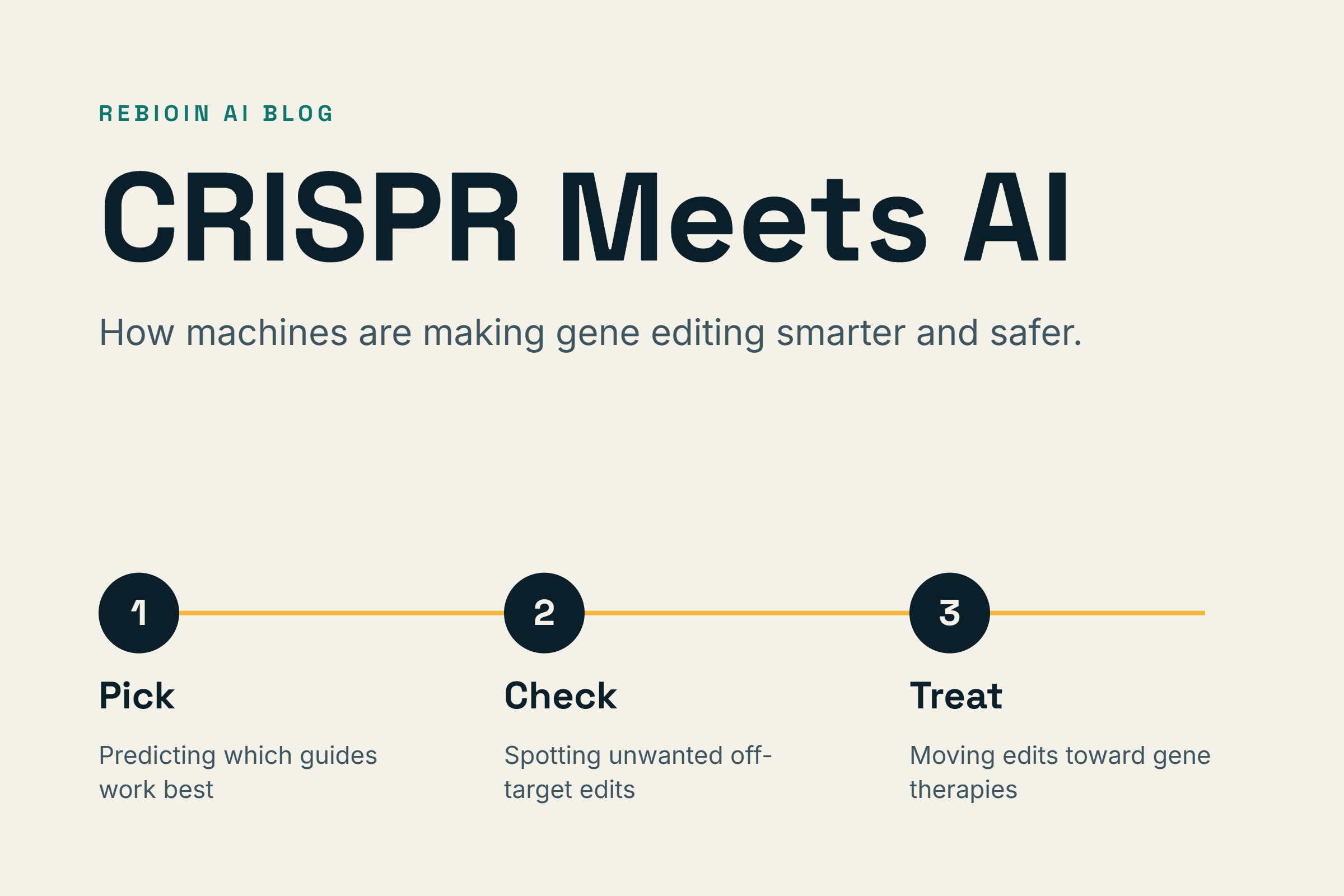
A case study: AI-designed CRISPR. CRISPR–Cas9 comes from bacteria, so it is not perfectly tuned for human cells. A team at Profluent Bio asked a different question: what if a language model could learn the "grammar" of CRISPR proteins and write new ones?
- They mined more than 1 million CRISPR operons from 26 terabases of assembled genomes and metagenomes [4].
- Their models generated proteins covering 4.8 times as many protein clusters across CRISPR–Cas families as are found in nature [4].
- One AI-generated editor, called OpenCRISPR-1, performed precision editing of the human genome and was compatible with base editing [4].
- In the preprint version of the work, OpenCRISPR-1 showed comparable activity and better specificity than SpCas9, the classic Cas9, even though it differs from it by about 400 mutations [5].
- The authors released OpenCRISPR-1 for broad use in research and commercial applications [4].
The idea to remember: instead of searching nature for a useful tool, scientists can now ask a model to propose candidates and then test them in cells.
3. AI is speeding up drug discovery
Developing a drug usually takes many years and has a high failure rate. AI is being used at several steps: finding a disease target, designing a molecule, and predicting how it will behave.
The most talked-about example is rentosertib (ISM001-055) from Insilico Medicine, a small-molecule drug for idiopathic pulmonary fibrosis (IPF), a progressive lung-scarring disease. According to the company, AI was used both to identify the target (an enzyme called TNIK) and to generate the molecule. In June 2025, a phase 2a randomised, double-blind, placebo-controlled trial was published in Nature Medicine [3]:
- 71 patients took part, and the drug met its primary safety endpoint [3, 6].
- After 12 weeks, patients on the 60 mg once-daily dose had an average gain of 98.4 mL in forced vital capacity (a lung function measure), while the placebo group declined by about 20.3 mL [6].
Now the honest part. This is a small, early-stage trial, and the authors themselves say larger and longer trials are needed [6]. Also, only 12 of 18 patients (67%) on the high dose completed the regimen, compared with 88% in the placebo group [7]. And analyses of AI-originated drugs so far suggest that they clear phase 2 at roughly the same rate (about 40%) as conventional drugs, with some high-profile failures along the way [7]. So AI is a powerful accelerator, not a magic wand.
4. What AI cannot do (yet)
If you are a wet-lab student worried that AI will replace you, here is the good news: every example above ended with an experiment.
- Predictions must be tested. AlphaFold gives a model, not a guarantee. The AI-designed CRISPR editor still had to be tested in human cells [4].
- Data decides quality. A model can only learn from the data it is given. Missing, biased or poorly labelled data leads to weak models.
- Biology is more than one protein. Cells, tissues and patients are far more complex than a single structure.
- Responsible use matters. Powerful design tools raise questions about safety, fairness and access. Open release (as with OpenCRISPR-1) helps research but also needs ethical use [4].
What should a life-science student do now?
- Learn the vocabulary. Terms like training data, model, prediction, validation and overfitting are as useful today as "buffer" and "control".
- Try the free tools. Look up a protein of interest in a public structure database and compare the prediction with the experimental structure.
- Ask good questions. The best AI projects start with a real biological problem, not with a fancy algorithm.
- Stay critical. Always ask: what data was this trained on, how was it validated, and what is the confidence?
- Bring both worlds together. The most valuable people in the next decade will be those who understand the wet lab and the data.
The bottom line
AI is changing biotechnology in three big ways: it helps us read biology (structure prediction), write biology (designing proteins and genome editors) and accelerate the path to medicines. But it works best as a partner to experiments, not a replacement. The scientists who thrive will be the ones who can ask a sharp biological question, let AI propose the answers, and then walk into the lab to check.
References
- Jumper, J., Evans, R., Pritzel, A., et al. Highly accurate protein structure prediction with AlphaFold. Nature 596, 583–589 (2021). https://doi.org/10.1038/s41586-021-03819-2
- Royal Swedish Academy of Sciences. Press release: The Nobel Prize in Chemistry 2024 (awarded to D. Baker, D. Hassabis and J. M. Jumper, 9 October 2024). NobelPrize.org. https://www.nobelprize.org/prizes/chemistry/2024/press-release/
- Xu, Z., Ren, F., Wang, P., et al. A generative AI-discovered TNIK inhibitor for idiopathic pulmonary fibrosis: a randomized phase 2a trial. Nature Medicine (2025). https://doi.org/10.1038/s41591-025-03743-2
- Ruffolo, J. A., Nayfach, S., Gallagher, J., et al. Design of highly functional genome editors by modelling CRISPR–Cas sequences. Nature 645, 518–525 (2025). https://doi.org/10.1038/s41586-025-09298-z
- Ruffolo, J. A., Nayfach, S., Gallagher, J., et al. Design of highly functional genome editors by modeling the universe of CRISPR-Cas sequences (preprint). bioRxiv (2024). https://doi.org/10.1101/2024.04.22.590591
- Insilico Medicine. Press release on the Nature Medicine publication of Phase IIa results of rentosertib (3 June 2025). https://www.eurekalert.org/news-releases/1086096
- Buntz, B. Insilico's AI-designed rentosertib shows promise in first phase 2a trial results. Drug Discovery & Development (5 June 2025). https://www.drugdiscoverytrends.com/insilicos-ai-designed-rentosertib-shows-promise-in-first-phase-2a-trial-results/