More Than Milk: How a Mother’s Milk May Help Shape a Baby’s Gut Microbiome
New research reveals a fascinating connection between breast milk and the tiny microorganisms living inside a baby's gut.
New research reveals a fascinating connection between breast milk and the tiny microorganisms living inside a baby's gut.
Category: Scientific Discoveries | Life Sciences | Microbiome Research
Meta title: How Breast Milk May Shape a Baby’s Gut Microbiome
Meta description: Discover how breast milk may influence a baby’s gut microbiome, what a 2025 scientific study found, and how bioinformatics helps researchers uncover hidden microbial connections.
Primary keyword: Breast milk and infant gut microbiome
A surprising connection between breast milk and a baby's gut
When we think about breast milk, we usually think about nutrition. It provides essential nutrients that help a baby grow and develop. But breast milk is more than a source of food. It contains antibodies, special carbohydrates, and other biological components that may influence how a baby's body develops. Scientists are also investigating another fascinating possibility: could the microorganisms present in breast milk be connected to the development of a baby's gut microbiome? The gut microbiome is the community of tiny organisms, including bacteria, that live in our digestive system. These organisms interact with the body in many ways, from helping process certain nutrients to influencing the development of the immune system. A study published in Nature Communications on 22 November 2025 explored the relationship between the microorganisms found in breast milk and those found in infants' guts. The researchers analyzed 507 samples from 195 mother–infant pairs. They found that some bacterial species and strains were shared between breast milk and infant stool samples. The findings provide new insights into how a baby's gut microbiome develops during early life. They also raise important questions about how microorganisms move between mothers and their infants. Let's explore what the researchers discovered and why this study matters.
1. What is the gut microbiome, and why is it important?
Our bodies are home to many microorganisms. The collection of these microorganisms in a particular environment is called a microbiome. The gut microbiome refers to the microorganisms living in the gastrointestinal tract, particularly the intestines. These microorganisms are not simply passive residents. Many interact with the body and contribute to normal biological processes.
For example, some gut bacteria help break down dietary components that the human body cannot digest efficiently on its own. Others produce substances that influence the intestinal environment and interact with the immune system. The gut microbiome begins developing early in life and changes as a baby grows. During the first months, its composition can be influenced by feeding, birth circumstances, maternal microorganisms, antibiotic exposure, and the surrounding environment. This makes early infancy an important period for studying how microbial communities form. Scientists want to understand which microorganisms establish themselves in a baby's gut, where they may come from, and how their presence changes over time.
2. What makes breast milk special?
Breast milk contains much more than proteins, fats, vitamins, and minerals. It also contains biological components that may influence the infant's gut environment.
Two particularly interesting components are its microorganisms and its special carbohydrates.
Microorganisms in breast milk
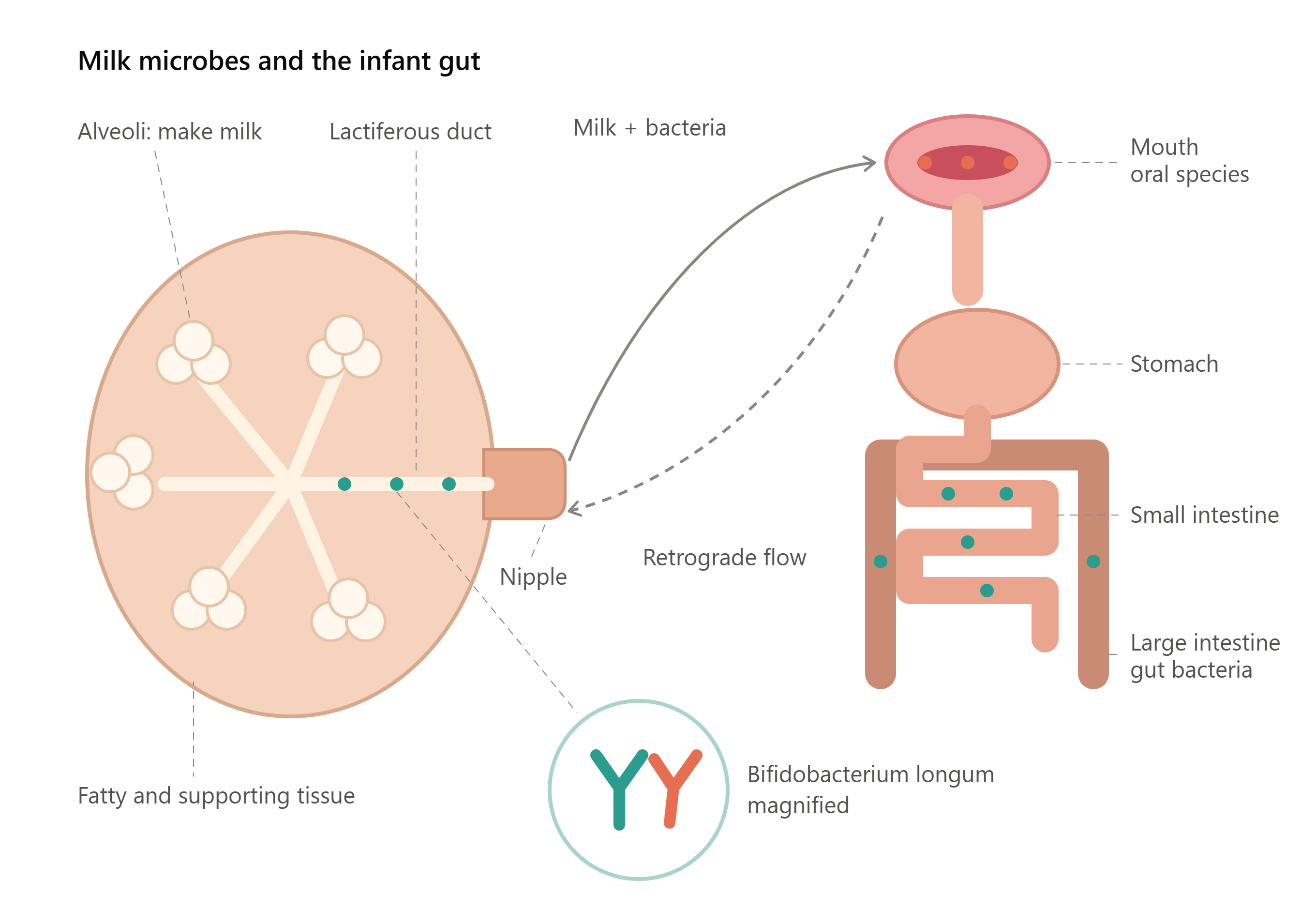
Researchers have detected various bacterial groups in human milk, including members of the genera Bifidobacterium, Streptococcus, and Staphylococcus.
Some of these bacteria have also been found in infant gut samples. However, detecting bacteria in breast milk does not automatically mean that every bacterium is beneficial or that it will establish itself in the baby's gut. Scientists need to investigate the identity of these microorganisms, their genetic characteristics, and their possible roles.
Human milk oligosaccharides: special food for certain bacteria
Breast milk also contains substances called human milk oligosaccharides (HMOs). HMOs are complex carbohydrates that infants do not digest directly in the same way as ordinary sugars. Instead, certain gut bacteria can use them as a source of energy. One important example is Bifidobacterium longum subsp. infantis, a type of bacterium that can use particular HMOs.
This creates an interesting relationship: breast milk supplies nutrients to the baby while also containing compounds that can support the growth of specific gut microorganisms. Researchers are studying how these different components work together to influence the developing infant gut microbiome.
3. The 2025 study: What did scientists investigate?
The study was titled “Assembly of the infant gut microbiome and resistome are linked to bacterial strains in mother’s milk.” The research team wanted to investigate how closely the microbial communities in breast milk and infant stool were related. They also examined whether the same bacterial strains appeared in both samples and how microbial communities changed during early infancy.
The study included:
- 195 mother–infant pairs.
- 507 metagenomic samples in total.
- Breast milk samples collected at approximately one and three months after delivery.
- Infant stool samples collected at approximately one and six months of age.
The researchers used a method called shotgun metagenomic sequencing to study the DNA of microorganisms present in these samples. In simple terms, this technique allows scientists to examine the genetic material of many microorganisms in a sample rather than studying just one organism at a time. This was particularly useful because the researchers wanted to understand not only which bacteria were present, but also whether closely related bacterial strains were shared between mothers and their infants.
4. Finding one: Bifidobacterium longum was an important part of the connection
One of the study's important findings involved a bacterium called Bifidobacterium longum. Members of the Bifidobacterium genus are commonly found in the gut of breastfed infants. Certain strains can use HMOs, allowing them to grow in the environment created by human milk. The researchers found that B. longum contributed substantially to the overlap between the bacterial species detected in breast milk and infant stool samples. They also observed that infant gut microbiomes dominated by B. longum showed greater stability over time than those dominated by other species.
What does this mean?
A stable microbiome is one whose overall microbial composition changes less between observations. In this study, infants whose gut communities were dominated by B. longum tended to show less change in their microbial composition between the sampled ages. This is an interesting association, but it does not prove that B. longum alone caused the greater stability or that this pattern guarantees better health. The result helps researchers identify a bacterial group worth studying further when investigating how the infant gut microbiome develops.
5. Finding two: Some bacterial strains were shared between mothers and infants
This was one of the most interesting parts of the study. Scientists can identify microorganisms at different levels. They may identify a broad group, a species, or a particular strain within a species.
A bacterial strain is a specific genetic variant or lineage within a bacterial species. Two strains may belong to the same species while differing in parts of their genetic makeup. For example, finding B. longum in both a mother's milk and her infant's stool does not necessarily mean that the bacteria are the same strain. To investigate this more closely, the researchers compared bacterial strains across samples. They reconstructed 77 strains and identified 12 instances of strain sharing between breast milk and infant stool, across six mother–infant pairs. These instances involved ten different bacterial taxa. The shared organisms included Bifidobacterium longum, Bifidobacterium bifidum, Escherichia coli, and Klebsiella pneumoniae, along with several other bacterial groups.
Why does this matter?
Finding closely matching strains in related samples provides stronger evidence of a microbial connection than finding the same species alone. However, there is an important limitation: the researchers could not establish that these bacteria had travelled directly from breast milk into the infant's gut. The same strain could potentially reach both environments through another source. In addition, the researchers detected shared strains belonging to bacteria commonly found in the mouth, suggesting that microbial movement between an infant's mouth and the mother's milk could also be involved. The study therefore provides evidence of microbial sharing, while leaving the exact route of transmission unresolved.
6. Finding three: The infant gut microbiome changes as a baby grows
The gut microbiome is not a fixed collection of microorganisms. It changes during early life as different bacteria grow, compete, and respond to their environment. The researchers compared infant stool samples collected at one and six months of age. They found that microbial communities changed over time and that only a proportion of the bacterial strains detected at one month remained detectable at six months. Approximately 19.4% of the strains identified in infant stool at one month persisted until six months in the study's analysis. The study also found an association between vaginal delivery and greater persistence of bacterial strains compared with caesarean delivery. This does not mean that delivery method alone determines the gut microbiome. Other factors may contribute, and the results should not be interpreted as proof that one delivery method guarantees a healthier microbial community. Instead, the findings show that the development of the infant gut microbiome involves several interacting factors and continues throughout early life.
7. What is the resistome, and why did researchers study it?
The researchers investigated another feature of the microbial community: the resistome. The resistome is the collection of antimicrobial resistance genes found in a microbial community.
Some bacteria naturally possess genes that help them resist particular antimicrobial substances. Other resistance genes can be acquired, and under certain conditions, these genes may spread between microorganisms. The researchers found that mother–infant pairs shared more antimicrobial resistance genes than would be expected by chance under their analysis. This is important because scientists need to understand not only which bacteria are present but also what genetic characteristics they carry. However, detecting an antimicrobial resistance gene does not mean that an infant has an antibiotic-resistant infection. A gene's presence is different from demonstrating that a microorganism is causing disease or that an infection will be resistant to treatment.
The findings highlight the value of studying the genetic characteristics of microbial communities alongside their composition.
8. How did bioinformatics help scientists discover these connections?
Microbiome research generates large amounts of genetic data. Identifying microorganisms and comparing their DNA across hundreds of samples would be difficult without computational methods. This is where bioinformatics becomes essential. Bioinformatics combines biology, computer science, and data analysis to study biological information. In this research, it helped scientists investigate the microorganisms present in breast milk and infant stool samples.
The workflow can be simplified into five steps.
Step 1: Sample collection
Researchers collected breast milk and infant stool samples at different time points.
Step 2: DNA sequencing
They used shotgun metagenomic sequencing to read genetic material from microorganisms present in the samples.
Step 3: Microbial identification
Computational tools analyzed the sequencing data to identify bacterial species and estimate their relative abundance.
The researchers used MetaPhlAn4 for taxonomic profiling.
Step 4: Bacterial strain comparison
The researchers used StrainPhlAn4 to compare bacterial strains across samples and identify instances in which closely matching strains were present in both breast milk and infant stool.
Step 5: Further genetic analysis
They also investigated microbial metabolic pathways and antimicrobial resistance genes to better understand the genetic characteristics of the microbial communities. Together, these methods allowed the researchers to move from millions of DNA sequences to meaningful biological observations. This is a good example of how bioinformatics helps answer questions that would be difficult to investigate through traditional laboratory observation alone.
9. What does this research mean for infant health?
The study provides evidence that some bacterial strains are shared between breast milk and infant gut samples. It also highlights the importance of Bifidobacterium longum and shows that microbial communities change during the first six months of life. These findings can help researchers investigate how the infant gut microbiome develops and how maternal, dietary, and environmental factors may contribute to its composition. In the future, this research may support a better understanding of early-life microbial development and its relationship with human health.
However, the study did not establish that a particular bacterial strain prevents disease, that breast milk is the only source of infant gut bacteria, or that changing the milk microbiome would necessarily improve health outcomes. More research is needed to establish the direction of microbial transmission and determine the long-term significance of these observations. The most valuable takeaway is that the relationship between breast milk and the infant gut microbiome is complex and deserves further investigation.
10. What are the limitations of the study?
Every scientific study has limitations, and understanding them helps us interpret the findings correctly. First, shared bacteria do not prove direct transmission. The same strain found in breast milk and infant stool could have reached both samples through another source. Second, strain sharing was observed in a limited number of mother–infant pairs. Although the study included 195 pairs, the researchers identified 12 instances of strain sharing across six pairs. These results should not be interpreted as evidence that all mothers transfer bacteria through breast milk.
Third, the study focused on a particular population. The participants were healthy, term infants and predominantly breastfeeding mothers recruited in Minneapolis, USA. The findings may not apply equally to all populations. Finally, identifying a microorganism does not establish its effect on health. Some bacteria may be beneficial in certain contexts, while others may behave as opportunistic pathogens. Their significance depends on factors such as the organism, its genetic characteristics, and the environment in which it is found. These limitations do not reduce the importance of the study. They help define what scientists have learned and what future research still needs to investigate.
Conclusion: A small microbial world with a big scientific story
Breast milk is more than a source of nutrition. It contains a complex mixture of nutrients, antibodies, bioactive molecules, and microorganisms that may be connected to the development of the infant gut microbiome. The 2025 study published in Nature Communications investigated this relationship by analyzing 507 metagenomic samples from 195 mother–infant pairs. Researchers found overlapping bacterial species, identified instances of strain sharing, and observed that infant gut communities dominated by Bifidobacterium longum tended to be more stable over time.
The study also examined antimicrobial resistance genes, showing how researchers can investigate not only which microorganisms are present but also the genetic characteristics of the communities they form. Importantly, the findings do not prove that breast milk is the sole source of an infant's gut bacteria or that every shared microorganism is beneficial. Instead, they provide evidence of a microbial connection that scientists can explore further. For life science students, the research also demonstrates how molecular biology and bioinformatics work together. By combining DNA sequencing with computational analysis, scientists can uncover patterns in complex biological systems that would otherwise remain difficult to detect. Sometimes, a familiar part of everyday life can reveal an entire world of scientific questions—one that becomes visible only when we look closely enough.
References
1. Primary research article
Ferretti, P., Allert, M., Johnson, K. E., Rossi, M., Heisel, T., Gonia, S., Knights, D., Fields, D. A., Albert, F. W., Demerath, E. W., Gale, C. A., & Blekhman, R. (2025). Assembly of the infant gut microbiome and resistome are linked to bacterial strains in mother’s milk. Nature Communications, 16, Article 11536.
https://doi.org/10.1038/s41467-025-66497-y
Full text: https://www.nature.com/articles/s41467-025-66497-y
PubMed record: https://pubmed.ncbi.nlm.nih.gov/41274878/
2. Earlier preprint of the same research
Allert, M., Ferretti, P., Johnson, K. E., et al. (2024). Assembly, stability, and dynamics of the infant gut microbiome are linked to bacterial strains and functions in mother’s milk. bioRxiv.
https://doi.org/10.1101/2024.01.28.577594
Full text: https://pmc.ncbi.nlm.nih.gov/articles/PMC10849666/
Reference note: The 2024 preprint is an earlier version of the same research, not a separate independent study. The final 2025 journal publication is the main reference for this article.
Explore More with Rebioin AI
Science becomes more powerful when everyone can understand it. Follow Rebioin AI for accessible, research-based articles exploring life sciences, genomics, microbiome research, bioinformatics, and artificial intelligence.